On 25 June 2026, a hybrid event on "Teaching with AI: New Ideas for Sustainable VET," hosted in Brussels as part of the AI & Sustainability in VET Education (AI-SAVES) project took place. The event brought together teachers, trainers, and VET organisations from across Europe to share what happened when real AI and electronics kits were placed in the hands of students.
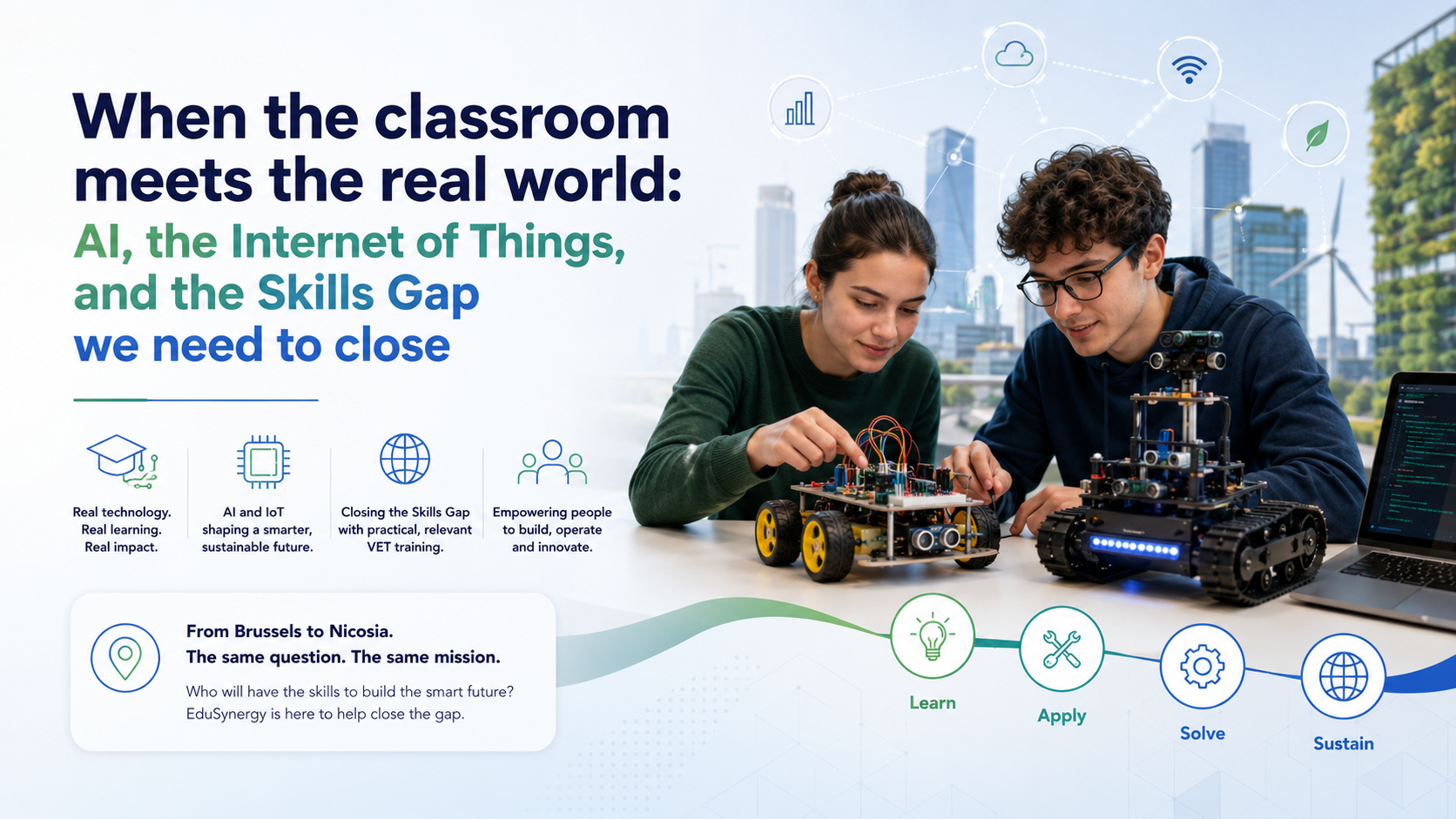
The kits in question were not simulations or software sandboxes. They were physical; Raspberry Pi-based wheeled robots with visible circuitry and breadboards, alongside more advanced tracked robotic platforms with sensor arrays and lighting systems. Students used these to design and prototype their own solutions to real sustainability challenges, such as smart waste management systems, energy efficiency tools, resource monitoring devices. The pedagogical model that made this work was deliberately co-creative: teachers learned alongside their students, students experimented, and students designed the solutions themselves.
Just three days earlier, on 22 June, the IET Cyprus Local Network hosted a roundtable at the Cleopatra Hotel in Nicosia titled "The Future of Smart Things." The event gathered experts from academia, industry, and research to examine how smart technologies, including AI, IoT, sensor network and intelligent systems, are transforming the built environment and the economy more broadly. The conversation touched on the convergence of AI with the physical world: not software operating in isolation, but intelligent systems interacting with buildings, infrastructure, and people in real time.
The two events, one in Brussels and one in Nicosia, were separated by three days and roughly 2,500 kilometres. But they were asking the same underlying question: who will have the skills to build, operate, and maintain these systems? And who is responsible for developing those skills?
This is precisely the question EduSynergy endeavours to answer and address.
EduSynergy is a VET centre currently pursuing HRDA certification in Cyprus. Our mission is to make the technologies currently shaping the smart economy, that is AI, IoT and digital tools, genuinely accessible to non-technical professionals through structured and certified training. Our depth of expertise stems from one of our core and sister organisations, PHOEBE Research and Innovation.
PHOEBE is not a newcomer to the territory the IET Cyprus roundtable was discussing. In fact, PHOEBE’s Director and Innovations Manager, Dr George Milis, was one of the roundtable’s panelists. PHOEBE has spent years building sensor-agnostic IoT systems that monitor building environments in real time, such as CO₂ levels, volatile organic compounds, temperature, humidity, energy use, and more. The applications currently under development include monitoring enclosed spaces and measuring the cognitive performance impact of indoor air quality (IAQ) in commercial workplaces. This is not research for its own sake. It is applied IoT work with a direct commercial and social purpose.
What this means for EduSynergy is that when we teach AI and IoT, we are not reaching for borrowed material. The technical understanding we bring into the training room is grounded in systems that we have designed and continue to design, build and deploy.
The Brussels event reinforced something that the smart technologies conversation in Cyprus often leaves unspoken: the challenge is not access to the technology. The hardware exists. The platforms exist. The challenge is pedagogical; building training environments where learners can move from understanding AI as a concept to using it as a medium for problem-solving.
The middle layer, people who understand the technology well enough to work with it meaningfully, without being the engineers who built it, is where the skills gap is most acute. And it is where EduSynergy's training programmes are designed to operate.