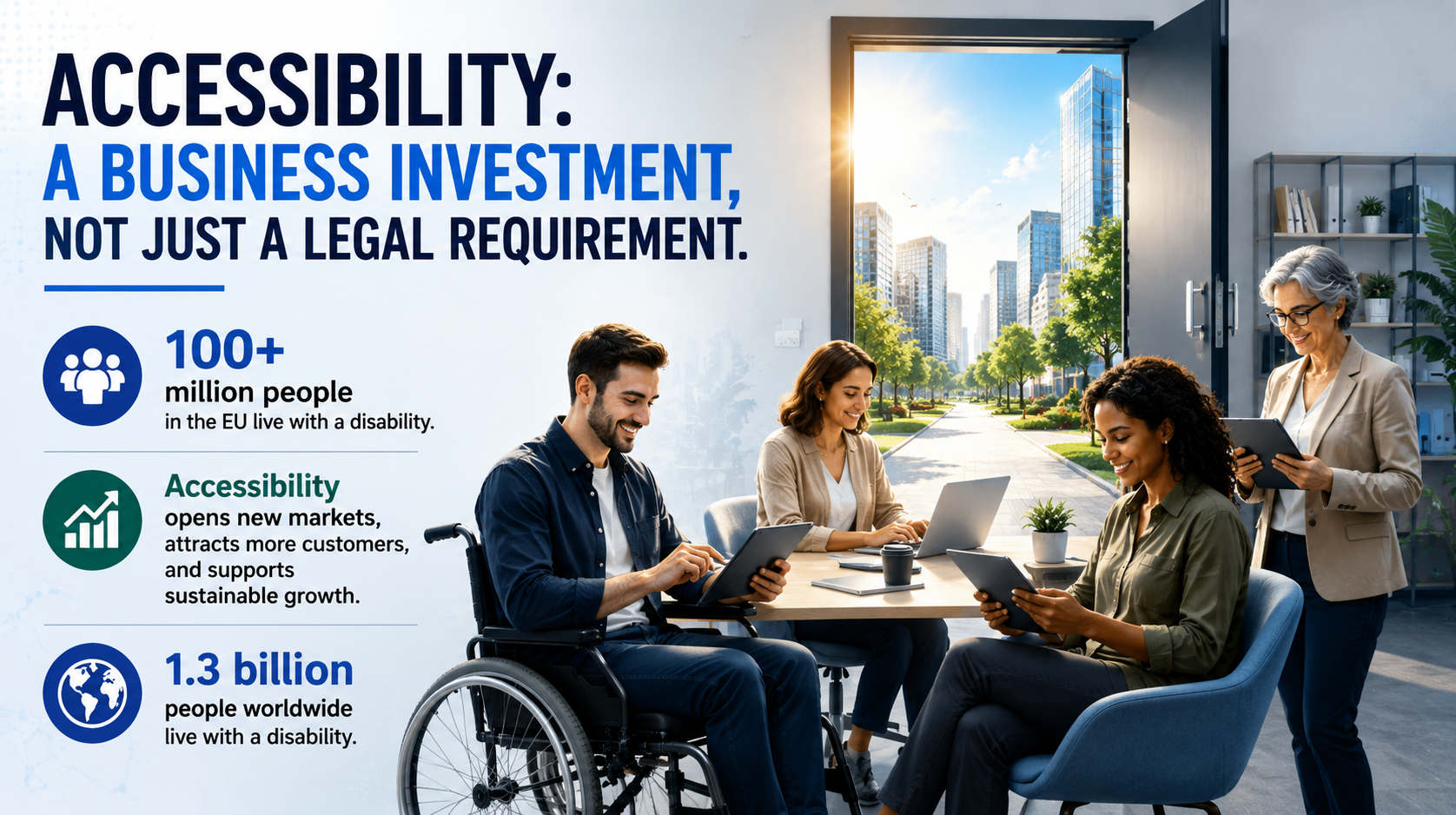
When businesses think about accessibility, they often focus on compliance with the European Accessibility Act (EAA). However, the real business case is much broader. Investing in accessibility enables organisations to reach new customer segments, improve user experience, strengthen their brand, and compete in both European and international markets.
Cyprus - An Economy That Depends on Inclusive Digital Services
Cyprus is a service-based economy, with tourism, financial services, higher education, professional services, shipping, and technology forming the backbone of its GDP. These sectors rely heavily on digital interactions, from booking systems and online banking to university admissions and e-commerce.
At the same time, Cyprus is experiencing demographic changes that make accessibility increasingly important:
- Around 17.7% of Cyprus's population is aged 65 or over, and this percentage continues to grow. An ageing population means more people experience age-related changes in vision, hearing, dexterity, and cognitive function, making accessible digital services essential rather than optional.
- Cyprus has also adopted the Accessibility of Products and Services Law of 2024, implementing the European Accessibility Act, with the law applying from 28 June 2025. This means many businesses offering digital products and consumer services must now ensure accessibility is built into their operations.
- According to the Cyprus Deputy Ministry of Social Welfare and Eurostat data, Cyprus continues to address employment and inclusion gaps affecting persons with disabilities, highlighting the importance of removing barriers to participation in society and the economy.
For Cyprus, accessibility is also a tourism opportunity. Every year, millions of visitors travel to the island. Many are older adults or travellers with disabilities who increasingly expect hotels, airlines, booking platforms, attractions, and public information to be digitally accessible before they choose a destination. Accessibility can therefore become a competitive advantage for the country's tourism sector.
Europe - A Market of More Than 100 Million People
Across the European Union:
- More than 100 million people live with a disability, representing one of Europe's largest and most underserved consumer groups. Combined with Europe's ageing population, this market continues to grow.
- In 2024, 87.2% of Europeans with disabilities used the internet, demonstrating that people with disabilities are active digital consumers who expect accessible websites, mobile applications, banking services, e-commerce platforms, and online customer support.
- The European Accessibility Act creates harmonised accessibility requirements across the EU, reducing barriers to cross-border trade and making it easier for businesses to offer accessible products and services throughout the Single Market.
This means accessibility is no longer only about serving local customers; it is about becoming competitive across the entire European market.
Global - The World's Largest Untapped Market
The business opportunity extends well beyond Europe. According to the World Health Organization (WHO):
- More than 1.3 billion people worldwide, approximately 16% of the global population, live with a significant disability. This represents one of the world's largest consumer groups.
When we include:
- older adults,
- people with temporary injuries,
- individuals experiencing situational limitations (such as using a mobile phone in bright sunlight or a noisy environment),
- and family members who make purchasing decisions,
the number of people who benefit from accessible products and services becomes even larger.
Research consistently shows that accessibility improvements benefit everyone by making products easier to use, improving customer satisfaction, and increasing overall usability.
Accessibility Opens Markets That Many Businesses Still Overlook
One of the greatest misconceptions is that accessibility only benefits a small percentage of the population.
In reality, businesses that invest in accessibility gain access to markets that have historically been underserved:
- Customers with disabilities who actively seek inclusive businesses.
- Older adults with growing purchasing power.
- International travellers who depend on accessible digital services.
- Public sector organisations and large enterprises that increasingly require accessibility from suppliers.
- European customers who expect organisations to comply with accessibility standards.
These markets are substantial, loyal, and growing.
For many organisations in Cyprus, accessibility represents one of the most overlooked opportunities for sustainable business growth.
Rather than asking, "How much will accessibility cost?", organisations should begin asking:
"How many customers are we currently excluding?"
Businesses that develop accessibility skills today are investing not only in compliance but also in innovation, customer experience, market expansion, and long-term competitiveness.
Accessibility is no longer simply about removing barriers.
It is about opening doors, to new customers, new partnerships, and new markets.
References
- European Commission - European Accessibility Act (Directive (EU) 2019/882).
- Cyprus Accessibility of Products and Services Law (2024): Iimplementation from 28 June 2025.
- Eurostat - Disability statistics: Access to Information and Communication Technologies.
- European Disability Forum - Cyprus Country Overview.
- Cyprus Government - Department for Social Inclusion of Persons with Disabilities.
- Cyprus Government - Tourism Statistics.
- Cyprus Government - Accessible Cyprus.
- World Health Organization - Global estimate of disability.