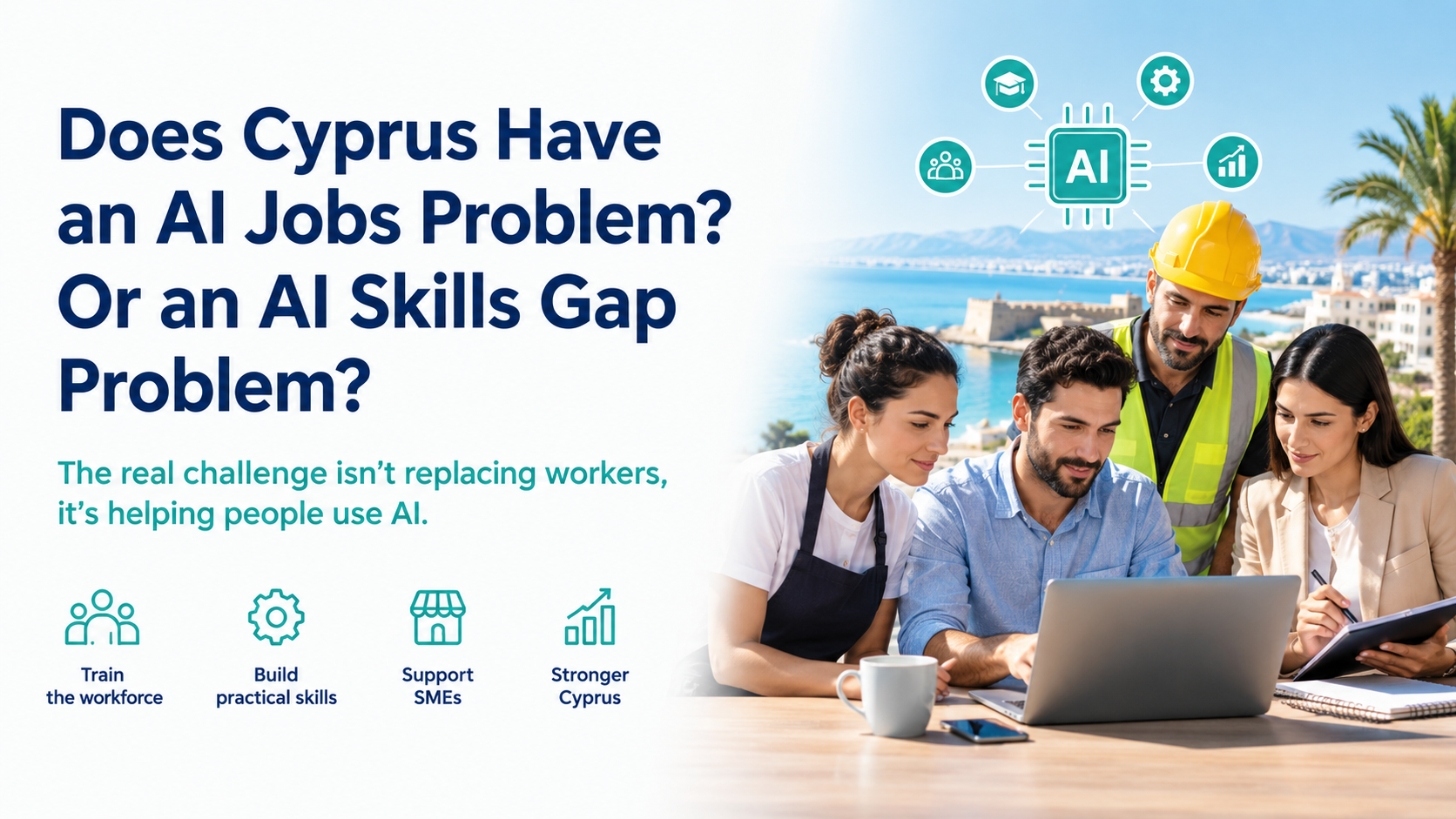
Cyprus's unemployment rate stood at just 4% in the first quarter of 2026, yet employers were struggling to fill almost 14,000 positions, most of them in construction, retail, tourism and food services. The Human Resource Development Authority (HRDA, known locally as ΑνΑΔ) expects the country to need around 11,700 new recruits every year through 2032, and more than half of those won't be new jobs at all. They'll be replacing people leaving the workforce for good, against the backdrop of a population that now has more people over 65 than children under 15. Whatever story Cyprus ends up telling itself about AI and employment this year, "robots taking up Cypriot jobs" won’t be it!
A recent figure from the International Labour Organisation (ILO), cited in the same Cyprus Mail news article, puts that mismatch in sharper focus: specialist AI and machine-learning skills make up only around 1% of what employers are actually asking for in online job postings. The demand isn't for a new generation of AI engineers. It's for people already working in traditional domains like construction firms, hotels, retail chains and accounting offices who can use AI-adjacent tools competently in the roles they already hold. Smart systems, in other words, were never really built for engineers alone. The vast majority of people who will end up using them for anything don't have "engineer" anywhere in their job title.
How much that distinction matters was illustrated by a field experiment in Kenya, referenced in the same piece: two groups of entrepreneurs were given access to the same AI tool, which offered them broadly similar business advice. The outcomes diverged sharply, not because of what the AI said, but because of what each group did with it. The more experienced, better-trained users questioned the advice, tested it and adapted it to their own circumstances. The others largely took it at face value. Buying access to AI, it turns out, is the easy part. Knowing what to do with it is the actual skill, and it isn't one most people pick up automatically.
The Dartmouth Summer Research Project on AI
That distinction is, in a strange way, almost as old as the field itself. This is roughly the seventieth (70th) summer since a small group of around ten researchers gathered at Dartmouth College in New Hampshire for what they called the Dartmouth Summer Research Project on Artificial Intelligence, running through July and August 1956. It was there that the term "artificial intelligence" was first put on paper, built on the working assumption that learning and intelligence could eventually be described precisely enough for a machine to simulate them. What's easy to forget, seventy years on, is that the hard part was never really the theorising. Getting from ten researchers in a room to a construction-site foreman or a hotel front-desk manager who can use the resulting tools competently has taken most of those seven decades, and by Cyprus's own vacancy numbers, it isn't finished yet.
Closing the skills gap
That gap, between what the technology can already do and what the people using it day to day actually know how to do with it, is precisely where training earns its keep. It's also why a small but growing number of practical, short-format courses are starting to appear that are explicitly built for operations managers, business owners and HR teams rather than engineers, including an HRDA-subsidised programme running this October on applying AI and IoT to everyday operations. Programmes like this aren't trying to turn a hotel manager into a data scientist. They're trying to close a much smaller, much more solvable gap: the one between owning a tool and knowing what to actually do with it.
Cyprus's coming labour shortage isn't going to be solved by AI replacing the workers who aren't there. If it gets solved at all, it will be because the workers who are there become more capable, faster to bring up to speed, and better equipped to use whatever tools arrive next. Seventy years after a room full of researchers first wondered whether a machine could simulate learning, the more pressing question in Cyprus this year isn't really about the machine. It's whether enough people have been taught to work alongside one.
Sources & further reading
- Cyprus Mail, "Can AI fill Cyprus' worker gap?", 2 August 2026
- Dartmouth College, "Artificial Intelligence (AI) Coined at Dartmouth"
- Wikipedia, Dartmouth workshop