
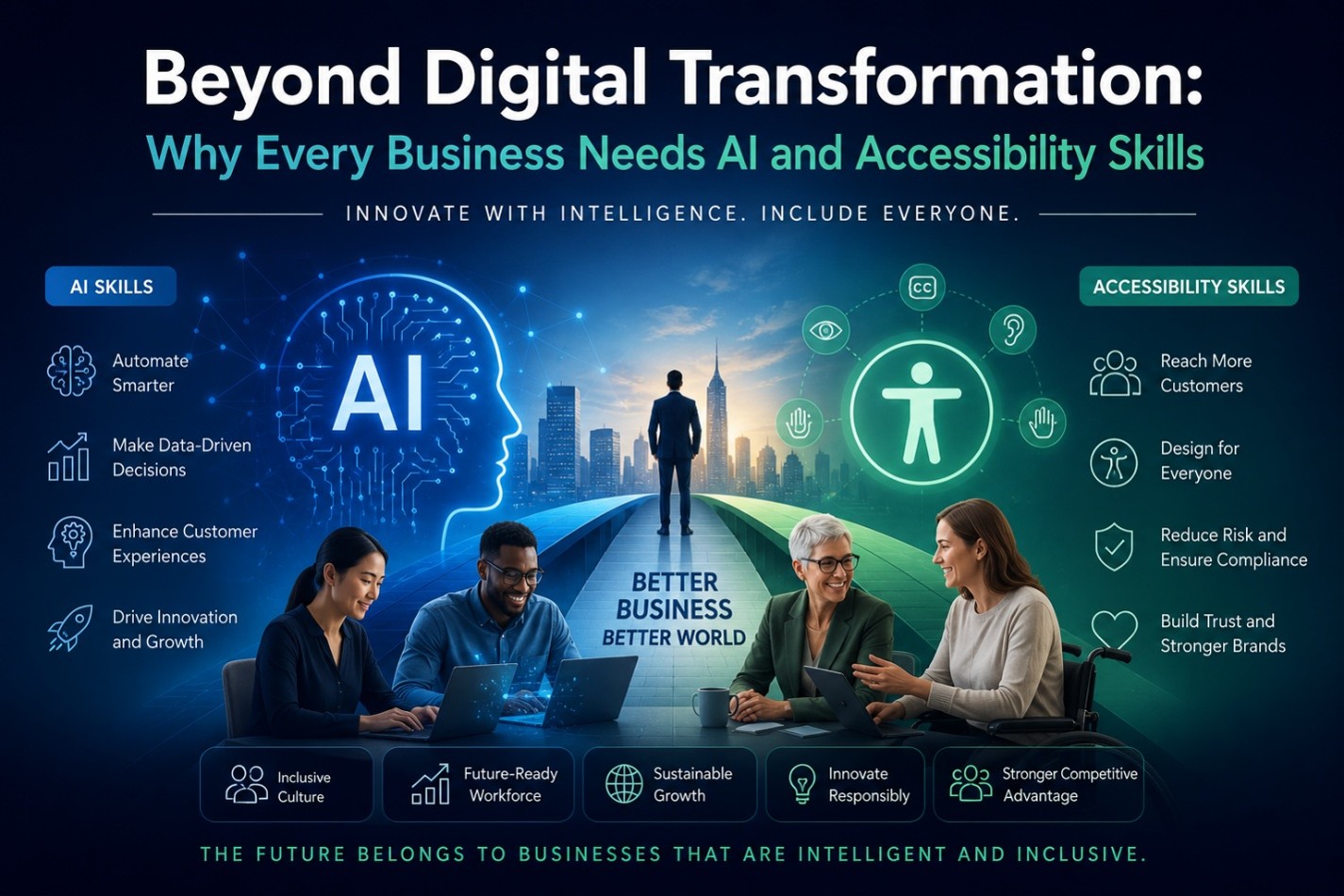
Artificial intelligence (AI) is transforming how organizations operate, while accessibility is reshaping how they design products, services, and experiences. Although these two fields are often discussed separately, they are becoming increasingly interconnected. Together, they represent two of the most important skill areas for businesses that want to remain competitive, innovative, and customer-focused.
AI is changing the way we work…
AI is no longer a futuristic concept. It is being used to automate routine tasks, analyze data, improve decision-making, enhance customer service, and accelerate product development. Organizations that equip their workforce with AI skills can improve productivity, reduce operational costs, and uncover new opportunities for growth.
However, AI is only as effective as the people who design, implement, and use it responsibly. Employees need the knowledge to work alongside AI tools, understand their limitations, and apply them ethically.
Accessibility expands business opportunities
At the same time, accessibility has evolved beyond a compliance requirement. It is now a strategic capability that enables organizations to create products and services that work for the widest possible audience, including people with disabilities, older adults, and users with temporary or situational limitations.
Businesses that prioritize accessibility often see benefits such as:
- Improved customer experience and satisfaction.
- Better product usability for all users.
- Reduced development costs by addressing accessibility early.
- Stronger brand reputation and customer trust.
- Greater market reach and inclusion.
Accessibility is no longer just the responsibility of specialists. Designers, developers, product managers, content creators, and business leaders all play a role in delivering inclusive experiences.
The power of combining AI and Accessibility
The greatest opportunity lies in combining AI with accessibility expertise. AI can support accessibility by generating captions, improving speech recognition, describing images, translating content, personalizing user experiences, and identifying accessibility issues during development. At the same time, accessibility principles help ensure that AI-powered products are usable, inclusive, and fair for diverse groups of people.
Without accessibility knowledge, AI solutions risk excluding users or introducing bias. Without AI skills, organizations may miss opportunities to improve efficiency and deliver more personalized experiences.
Together, these capabilities enable businesses to create technology that is both innovative and inclusive.
Why Business Leaders Should Invest Now
Organizations that build AI and accessibility skills across their workforce are better prepared for the future. These skills help teams:
- Develop higher-quality digital products.
- Innovate with greater confidence.
- Reach broader customer markets.
- Reduce legal and operational risks.
- Foster a culture of inclusion and continuous improvement.
- Enhance customer experience
Rather than treating AI and accessibility as separate initiatives, forward-thinking organizations are integrating them into their digital transformation strategies.
Conclusion
The future of business depends on much more than merely adopting new technologies; it depends on using them effectively and responsibly. AI provides the tools to transform how work gets done, while accessibility ensures those innovations are usable by everyone.
Organizations that invest in both AI and accessibility skills will be better positioned to innovate, serve diverse customers, attract talent, and build sustainable competitive advantage. In today's digital economy, these are no longer an optional skill; they are essential business capabilities.